
Why Are Stratasys Materials So Expensive?
If you operate a Stratasys Fortus system, you’ve likely noticed that material costs are significantly higher than most industrial 3D printing platforms. This isn’t accidental or purely profit-driven—there are real, technical reasons behind the pricing. Below, we explain the key factors that drive Stratasys material costs without marketing spin, and when those costs might actually be justified.
For Fortus users evaluating material options, understanding how Fortus-compatible materials differ from OEM offerings is an important part of that decision.
-
Aerospace and medical certifications require extensive testing and strict traceability—costs that Stratasys passes onto the consumer. While this is critical for regulated production, not every user needs this level of certification.
• Aerospace-grade certifications for ULTEM™ 9085 and other advanced materials
• Strict mechanical property validation and lot traceability
• Batch-specific records tracked globally for audit purposesNot every user needs this level of certification, but the costs are baked into the price of every spool and canister.
Material Certifications Matter—for Some Industries
• In highly regulated fields such as aerospace and medical, certified material is often non-negotiable.
• Other users might prioritize cost efficiency over certification-level repeatability.
• For Fortus users focused on internal, R&D, or prototyping parts, alternatives can offer significant cost savings. -
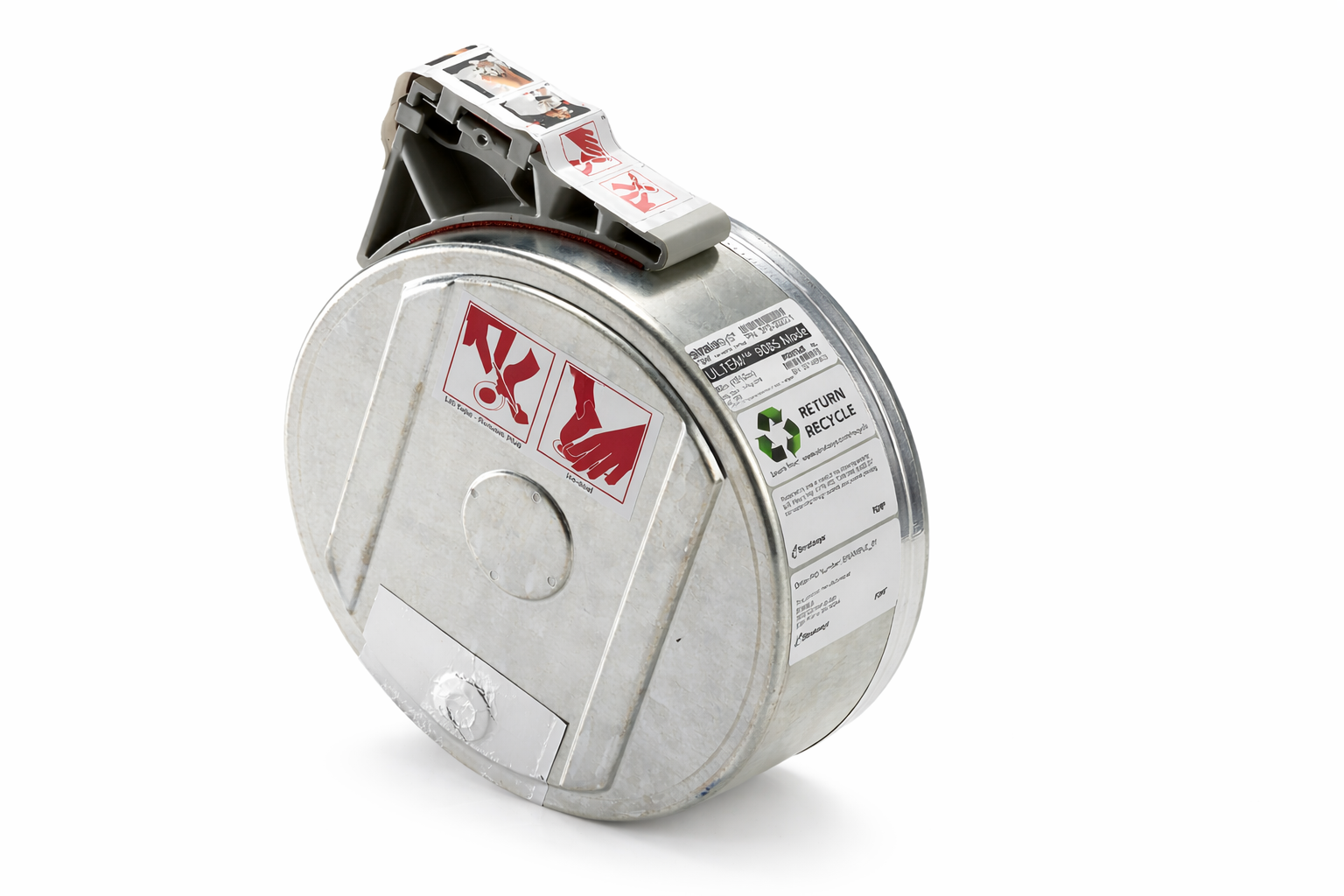
Stratasys materials are sold as part of a tightly controlled hardware ecosystem rather than as open filament spools. Each Fortus material canister contains an embedded identification chip that communicates with the printer, verifying material type, volume, and usage limits.
This system allows Stratasys to tightly control print reliability and repeatability, but it also removes competitive pressure from the materials supply chain.
Key cost drivers include:
Proprietary canister hardware designed specifically for Fortus systems
Embedded EEPROM chips used for material authentication and tracking
Locked material ecosystems that prevent open-market sourcing
Limited third-party competition for Fortus-compatible consumables
Because the printer is designed to accept only approved canisters, material pricing is not driven by raw resin cost alone. Instead, pricing reflects a bundled system of hardware, electronics, validation, and supply control.
This approach prioritizes consistency and support, but it also results in significantly higher per-part material costs compared to open or semi-open industrial FDM platforms.
-
Stratasys pioneered commercial fused deposition modeling (FDM) and spent decades developing hardware, materials, and process controls that few competitors could match at the time. For many years, Fortus systems were among the only platforms capable of maintaining a true high-temperature, fully enclosed build environment suitable for engineering-grade thermoplastics.
This early technical advantage allowed Stratasys to establish a dominant position in high-performance FDM long before meaningful competition existed.
Contributing factors include:
Early development of actively heated build chambers
Tight integration between hardware, materials, and software
Extensive process knowledge accumulated over decades of production use
Long-term customer adoption in aerospace, defense, and industrial manufacturing
Because of this head start, Stratasys was able to define both the technical standards and the commercial model for industrial FDM materials. Limited competition in this space for many years meant that pricing was not driven by an open market, but by a controlled ecosystem built around reliability and repeatability.
Even today, relatively few FDM platforms can match the thermal stability and process control of Fortus systems, which is why they remain widely used for high-temperature and regulated applications — despite higher material costs.
-
Stratasys material pricing also reflects a high level of control over resin selection, filament processing, and print consistency. Industrial FDM systems depend on predictable thermal behavior and mechanical performance, especially when operating in fully heated chambers at elevated temperatures.
To support this, Stratasys applies strict controls throughout the material supply chain, including:
Careful resin grade selection tailored for high-temperature FDM processing
Tight diameter and ovality control to ensure consistent extrusion
Moisture management and sealed packaging to maintain material condition
Process validation to ensure repeatable print performance across machines
These controls reduce variability during printing, which is critical for applications where dimensional stability, layer adhesion, and mechanical properties must remain consistent from build to build.
Achieving this level of repeatability requires more than raw resin—it depends on controlled extrusion, packaging, and qualification processes that add cost but reduce risk during production.
For users printing functional or regulated parts, this consistency is often worth the premium. For others, especially internal production or R&D environments, similar process control can be achieved without the same level of overhead when materials are developed and validated specifically for Fortus systems.
-
Despite their higher cost, Stratasys materials remain the right choice in certain situations where risk tolerance is low and qualification requirements are strict. In regulated or customer-mandated environments, the value of certified, OEM-supported materials can outweigh their cost.
Stratasys materials may be the appropriate option when:
Parts are produced for aerospace, defense, or medical applications requiring formal certification
Customer contracts or internal standards mandate OEM material usage
Long-term production programs depend on locked, repeatable process qualification
External audits require documented traceability and global material support
Downtime or process variability carries significant financial or regulatory risk
In these cases, the higher material price is often justified by reduced compliance risk, simplified validation, and standardized global support.
For organizations operating under these constraints, Stratasys materials provide a known, fully supported baseline that minimizes uncertainty across machines, facilities, and operators.
-
For many Fortus users, especially those focused on internal production, tooling, or R&D, the full cost and certification overhead of OEM materials may not be necessary. In these cases, compatible materials developed specifically for Fortus systems can offer a more efficient balance between performance, reliability, and cost.
Compatible materials often make sense when:
Parts are produced for internal use, tooling, or non-regulated applications
Cost reduction is a priority without compromising print stability
Material behavior has been validated in the same hardware and chamber conditions
Users require flexibility in material selection or iteration speed
Production volumes make OEM material costs difficult to justify
When properly developed, processed, and packaged, Fortus-optimized compatible materials can deliver consistent mechanical performance and reliable print behavior without the same level of ecosystem overhead.
For many organizations, this approach allows Fortus systems to remain highly productive and competitive while significantly lowering ongoing material costs—particularly in environments where certification is not a requirement.
Key takeaway
Why OEM pricing is high (without the marketing spin)
Stratasys® Fortus® material pricing is not driven by raw resin cost alone. It reflects a locked canister ecosystem, certification and traceability overhead, and tightly controlled process parameters designed for repeatability across regulated environments.
- Best fit for: regulated programs, mandated OEM usage, or low risk tolerance environments.
- Often unnecessary for: internal R&D, tooling, fixtures, and non-regulated production.
- Practical next step: compare pricing by 92 in³ and $/in³ to budget accurately.
Related resources
Continue through the pricing cluster to compare 92 in³ cartridge pricing, cost per cubic inch, and production budgeting tools.